UISS Update
UISS Supply Chain Excellence: Celebrating Innovation and Leadership
What an incredible UISS 2025 Supply Chain Symposium! Thank you to all attendees who joined us at Turning Stone Resort on September 18th. From AI policy updates to supply chain innovation strategies, we covered the critical topics shaping healthcare’s future.
Special thanks to our presenting sponsors Nexera and BRG for making this event possible. And to our speakers, Dr. David Dobrzkowski, renowned Supply Chain Professor from the University of Arkansas for his insightful talk on the adoption of AI in supply chain and strategic planning, and Mason Ingram from Premier for his DC policy update on Artificial Intelligence, Interoperability and the Health Tech Ecosystem.
The energy and collaboration at this year’s symposium reinforced what we already know: supply chain professionals are the backbone of healthcare delivery, driving innovation, managing unprecedented challenges, and ultimately enabling better patient care across our region. And as we celebrate Supply Chain Executives Week (October 5-11), we’re reminded once again of the vital leadership these professionals provide every single day.
Celebrating Our Industry’s Best
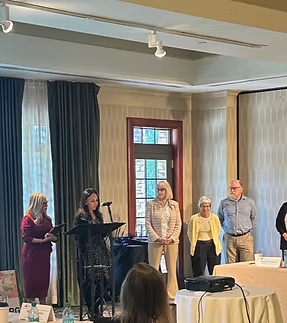
This year’s symposium was particularly special as we honored outstanding achievement across multiple dimensions of supply chain excellence. We were proud to present the UISS 2025 Supply Chain Recognition Award to SUNY Upstate Medical University, whose transformative work over the past year exemplifies the innovation and dedication that define our industry.
In the following articles, we spotlight SUNY Upstate Medical University’s remarkable achievements and examine how the continuum of care approach is reshaping healthcare supply chain strategy.
Feature: SUNY Upstate Medical University – 2025 UISS Supply Chain Recognition Award Winner
Transforming Healthcare Delivery Through Supply Chain Innovation
Congratulations to SUNY Upstate Medical University, winner of the UISS 2025 Supply Chain Recognition Award! Their innovative approaches to healthcare supply chain management exemplify the excellence we celebrate in our industry. This well-deserved recognition highlights Upstate’s commitment to operational transformation, strategic cost management, and delivering exceptional patient care through supply chain innovation.
Over the past year, Upstate’s Supply Chain team has achieved remarkable results that demonstrate the profound impact strategic supply chain management can have on healthcare delivery. From automation initiatives that streamline operations to crisis management that ensures continuity of care, their accomplishments span the full spectrum of supply chain excellence.
We sat down with Upstate’s Supply Chain leadership, Stephanie Shattuck, to learn more about their journey and vision for the future.
Pictured (right): StephanieShattuck, Associate Administrator for Support Services at State University of New York Upstate Medical University
Automation: Building Efficiency at Scale
Q: Your team has implemented several major automation initiatives this year. What’s driving this focus on technology, and what results are you seeing?
Upstate has embraced technology as a cornerstone of operational improvement, implementing multiple automation initiatives that are delivering measurable results.
The team designed and implemented an electronic interface to transmit AP invoice vouchers directly to New York’s Financial Management System (FMS) for payment. This innovation has transformed their accounts payable performance, with Upstate Hospital now paying invoices 94% within 30 days—a significant achievement that strengthens vendor relationships and optimizes cash flow management.
Recognizing that purchase order line items don’t always align perfectly with invoices, the team developed an invoice smoothing capability that facilitates matching and accelerates payment processing. They’ve also launched “Req to check,” which fully automates the scanning, ordering, receiving, and invoice payment of numerous Supply Chain items, eliminating manual touchpoints and reducing processing time.
Q: Tell us about your RPA implementation. How is robotic process automation changing your operations?
Perhaps most impressively, Upstate automated the PO order placement process using Robotic Process Automation (RPA) BOT technology. With Hospital Purchasing issuing approximately 60,000 purchase orders annually, this automation is streamlining operations and freeing buyers to focus on more complex, strategic issues that require human judgment and expertise.
Q: The specialty mattress rental tracking achievement is remarkable—reducing costs from $300,000 to $25,000. How did this come about?
In a creative application of technology, the team created the ability to track specialty mattress rentals via Epic data order sets. The results have been extraordinary: overall rental costs have plummeted from over $300,000 to less than $25,000 in just two years—a 92% reduction. Building on this success, they’re now working to create a similar process to manage wound vacs.
Crisis Management: Navigating the IV Fluid Shortage
Q: The national IV fluid shortage from October 2024 through March 2025 tested healthcare supply chains across the country. How did Upstate navigate this crisis?
When crisis struck in the form of a national IV fluid shortage from October 2024 through March 2025, Upstate’s Supply Chain team demonstrated exceptional leadership under pressure. The team strategically managed Upstate’s significantly reduced Baxter IV fluid allocation—in some cases reduced by as much as 80%—ensuring uninterrupted patient care during a critical period.
Q: With allocations cut by up to 80%, what strategies did you employ to maintain operations?
Their approach was comprehensive and proactive. The team actively managed inventory levels for over 60 Baxter products, developed contingency plans with Pharmacy to potentially compound product for hospital use if needed, expedited shipments from alternative sources, and enacted conservation measures by reducing PAR levels and redirecting surplus clean room product back to the warehouse.
These coordinated efforts contributed to overall continuity of operations and, most importantly, allowed Upstate to continue delivering life-saving patient care and surgeries to the Central New York community without disruption. It’s a powerful example of how supply chain excellence directly impacts patient outcomes.
Strategic Sourcing: Driving Value and Efficiency
Q: You established a strategic sourcing group within Hospital Purchasing. What was the catalyst for this, and what have been the early wins?
Upstate established a strategic sourcing group within Hospital Purchasing to strengthen procurement and operational oversight. This new team wasted no time making an impact, initiating an implant standardization bid that consolidated twenty-two vendors down to two prime vendors. The result? Over $1.5 million in annual savings while maintaining quality and service levels.
Q: In an environment of significant healthcare inflation, you held overall med/surg costs to just 0.45% year over year. How did you achieve this?
Despite inflationary pressures affecting healthcare nationwide, Upstate held overall med/surg costs to just a 0.45% increase year over year—a remarkable achievement that reflects disciplined procurement practices and strategic vendor management.
Building the Future Workforce
Q: Healthcare supply chain faces ongoing workforce challenges. How are you addressing talent development and recruitment?
Recognizing that supply chain excellence depends on attracting and developing top talent, Upstate successfully launched an internship and co-op program with Le Moyne College and Rochester Institute of Technology. These partnerships allow local students to receive hands-on job experience, learn meaningful skills, and explore careers within healthcare supply chain management.
Q: Tell us about your innovative approach to converting interns into full-time employees.
In collaboration with HR, Supply Chain developed an innovative initiative whereby intern and co-op experiences count toward minimum job experience requirements, creating a clear pathway for onboarding new graduate talent. The program has already yielded its first success: a former RIT co-op reported for duty as a full-time hire in August, bringing fresh perspectives and energy to the team.
Asset Management: Establishing a New Baseline
Q: You undertook a comprehensive asset management initiative. What prompted this, and what was involved?
Upstate initiated and completed a comprehensive top-to-bottom inventory and RTLS (Real-Time Location System) tagging of all mobile equipment. This massive undertaking counted, tagged, and tracked over 9,000 items, allowing Upstate to establish a new inventory baseline and cleanse outdated data from their systems. The improved visibility and accuracy enables better asset utilization, reduces unnecessary purchases, and ensures equipment is available when and where it’s needed.
Prime Vendor Conversion
Q: You recently completed a major prime vendor conversion. How did you manage this transition?
Upstate recently completed a conversion to Cardinal Health Services as part of the three SUNY Hospital system bid award, demonstrating their ability to manage large-scale operational changes while maintaining service continuity.
A New Service Delivery Model: Shifting Work to Enable Care
Q: One of your most innovative initiatives is embedding supply chain professionals directly in care delivery locations. What inspired this approach?
Perhaps one of Upstate’s most innovative initiatives is their new service delivery model that embeds supply chain professionals directly where care is delivered. As Upstate expands its footprint into external buildings, Supply Chain is placing dedicated professionals at locations such as Nappi and Verona Cancer Center.
Q: What do these embedded supply chain professionals actually do day-to-day?
These embedded staff members partner with clinical teams to set PAR levels, optimize product placement in clean supply rooms, scan and order materials including specialty items, and handle receiving and mail. This model strategically shifts supply-related work from clinicians to supply chain professionals, giving clinical staff more time for direct patient care.
Q: You piloted a similar “zone” concept within Inpatient Services. How does that work?
Building on this success, Supply Chain piloted a similar “zone” concept within Inpatient Services. Supply chain professionals are now responsible for designated zones of nursing units, providing supply management of clean rooms, restocking PPE, and stocking inpatient room carts. When the program is fully rolled out, Upstate estimates it will return over 6,000 hours annually to nursing staff for patient care—a significant win for both operational efficiency and patient experience.
Value Analysis: Strategic Decision-Making
Q: You’ve strengthened your value analysis structure. Tell us about the new Value Analysis Steering Committee.
Upstate launched a Value Analysis Steering Committee comprised of senior hospital leadership to guide and set VA policy and goals. They’re expanding their existing Med/Surg and OR teams with a new Procedural team, ensuring rigorous evaluation of products and technologies across all clinical areas.
A Vision for the Future
Q: Looking ahead, what’s your strategic vision for Upstate’s Supply Chain?
Looking ahead, Upstate’s Supply Chain Management leadership has articulated a clear vision built on four strategic pillars:
Technology: Leverage technology where practical to enhance supply chain operations and reduce costs, continuing the automation journey they’ve begun.
Data: Develop the analytics capabilities to understand and see trends within their data to drive decision-making. This includes a focus on data integrity, transparency, and meaningful metrics that inform strategy.
People: Ensure the right person is in the right seat doing the right job through strategic recruitment and retention, while upskilling the workforce to meet evolving skill requirements in an increasingly digital supply chain environment.
Customer Service: Understand what our customers want and need so that Supply Chain can deliver quickly and efficiently, positioning supply chain as a true service partner to clinical operations.
SUNY Upstate Medical University’s recognition as the 2025 UISS Supply Chain Recognition Award winner reflects more than a year of impressive achievements—it represents a comprehensive transformation of how supply chain can and should function in healthcare. By embracing automation, navigating crisis with grace, driving strategic value, developing future talent, and innovating service delivery models, Upstate has set a standard of excellence for our entire industry.
Their success reminds us that supply chain is not a back-office function—it’s a strategic enabler of patient care, a driver of financial sustainability, and a critical partner in healthcare’s mission. Congratulations to the entire Upstate Supply Chain team on this well-deserved honor!
Automation: Building Efficiency at Scale
Q: What inspired your aggressive push toward automation, and what advice would you give other organizations just beginning their automation journey?
Automation is a necessity given the environment in which we find ourselves coming out of COVID. We have to do more with less staff, as hiring continues to be a challenge. We also need quick access to reliable data in order to make sound business decisions and adapt to unanticipated national supply chain challenges. Automation also gives us the ability to reposition our workforce to focus on higher level tasks, while the systems facilitate some of the routine tasks.
Best advice I can give is to follow the principle of “crawl, walk, run.” Start small with a project or task, build competence, and implement successfully. Once that’s done, move on to the next task. It becomes a series of small “wins” that gradually build into a larger success. This allows you to focus and effectively manage the change, allow the staff to adapt to the new procedures, and have time to monitor and “tweak” the process.
Crisis Management: Navigating the IV Fluid Shortage
Q: What lessons from managing the IV fluid shortage have shaped your approach to building supply chain resilience for future disruptions?
We’ve learned to maintain situational awareness of all events that happen on a national level. Meaning, if there’s a hurricane bearing down on a particular region, we discuss what manufacturers are in its path and what possible impact an event can have on our inventory.
Our Supply Chain Distribution Center buyers are very in tune with any market fluctuation with respect to products. They pivot quickly and begin to source alternative products as soon as possible.
Communication is key. We have a lot of discussions with the Supply Chain leadership team to fully understand the impact of the situation across all of our business areas. We also have a “War room” style white board/Teams Room where we track all actions, action owners, responses, and due dates while in the midst of the crisis. It keeps us organized and on track.
Develop the ability to design and deploy quick data visualization tools of key inventory. This creates transparency into products and inventory levels and also creates a sense of security amongst clinical staff. They can see for themselves we have X days on hand of Y product. We use tableau and push out daily product reports to those who wish to be on the distribution list. It also reduces the number of calls and emails one has to respond to, allowing us to focus on the event.
Strategic Sourcing: Driving Value and Efficiency
Q: How did you gain physician buy-in for the implant standardization initiative, and what was your approach to balancing clinical preference with cost efficiency?
We partnered with physicians and invited them to be a part of the bid evaluation process providing us with their technical expertise.
Building the Future Workforce
Q: What has the response been from students, and how are you structuring these programs to provide meaningful experiences?
Students who intern/co-op with us value the time they spend with us. I recently received an email from one summer intern who wrote, “I am so grateful to have had the chance to meet and work alongside the amazing people of CES — their kindness, professionalism, and commitment to Upstate made a lasting impression on me. My time with CES gave me both valuable experience and a deeper appreciation for the work being done at Upstate every day, and I’ll carry those lessons with me into my senior year and beyond.”
The Supply Chain Directors put forth a request to “host” an intern/co-op. In this request, the Director outlines the types of duties/experiences the student will have. This forms the job description which we share with the colleges with whom we’ve partnered. Some projects our interns/co-ops completed include: building PAR levels and Clean Supply rooms for the new Nappi building; researching, selecting, and implementing GPS software on our delivery trucks to build better routes; and development of software tools to use in our data analysis. We want the students to have a very “hands-on” and successful experience so that they will consider working for us post-graduation, and also share their experiences with classmates to help us recruit the next group of interns/co-ops.
Asset Management: Establishing a New Baseline
Q: What immediate benefits have you seen from improved asset visibility?
We’ve cleaned up our records and have better insight into the amount, type, and lifecycle of our equipment.
A New Service Delivery Model: Shifting Work to Enable Care
Q: Returning 6,000 hours to nursing is significant. How did you calculate this impact, and what has been the response from nursing leadership?
We worked with Nursing leadership to identity certain supply chain type tasks Nursing performed. We then did a time study regarding how long certain tasks took, such as stocking PPE holders, and calculated the number of hours Nursing would save if Supply Chain performed those tasks. The response from Nursing has been very positive and they’ve become our biggest supporter of the pivot and subsequent request for additional FTE to support full implementation.
Q: As you expand this model, what challenges have you encountered?
A Vision for the Future
Q: Among your four strategic pillars—Technology, Data, People, and Customer Service—which do you see as most critical for the next phase of your journey?
They are all equally important because these are key to running a successful business.
Q: You’ve accomplished so much in the past year. What’s next on the horizon?
We are looking to continue introducing more automation into the Procure to Pay value stream; in particular automating our Receiving dock workflow and function. We also are learning more about AI and its impact on Supply Chain operations. We see diving into that realm where it makes sense. And lastly, Upstate University Hospital has a lot of expansion plans, in particular, building a new Emergency Department and Burn Center. We will be involved with those efforts, planning how to deliver our services in the new footprint.
Q: What advice would you give to other healthcare supply chain leaders who want to drive similar transformational change in their organizations?
- Set the vision with input from the Supply Chain leadership team. Communicate that vision both internally and externally so everyone knows what Supply Chain wants to accomplish.
- Build the business case for change. Be able to articulate why the change is needed, what will be the impact/results of the change, and how it will improve patient care/hospital operations.
- Employ good project management principles to drive and successfully manage the change effort.
- Start small and get early wins. This helps to build Supply Chain’s “credibility” and shows the staff the importance of the change.
- Transformational change doesn’t have to be big. Sometimes it’s solving the little problems that no one has addressed for a while.
SUNY Upstate Medical University’s recognition as the 2025 UISS Supply Chain Recognition Award winner reflects more than a year of impressive achievements—it represents a comprehensive transformation of how supply chain can and should function in healthcare. By embracing automation, navigating crisis with grace, driving strategic value, developing future talent, and innovating service delivery models, Upstate has set a standard of excellence for our entire industry.
Their success reminds us that supply chain is not a back-office function—it’s a strategic enabler of patient care, a driver of financial sustainability, and a critical partner in healthcare’s mission. Congratulations to the entire Upstate Supply Chain team on this well-deserved honor!