
U.S. Tariff Policy Updates
PLEASE NOTE: The information provided in this resource page reflects the latest available insights on tariff developments at the time of publication. Given the dynamic nature of trade policies, regulations, and market conditions, updates may occur frequently. Readers are encouraged to verify details with official sources (www.whitehouse.gov) and industry experts, as prior posts serve as point-in-time references and may not reflect the most current changes.
Pharmacy Tariff Report – March 2026
Pharmaceutical Tariffs: What We Know
The global trade landscape is shifting, and pharmaceutical tariffs remain a critical topic for health systems and suppliers alike. Our latest report breaks down:
✅ Recent trade agreements and exemptions✅ Potential impacts on brand and generic pharmaceuticals
✅ Inflation projections and strategies for FY26
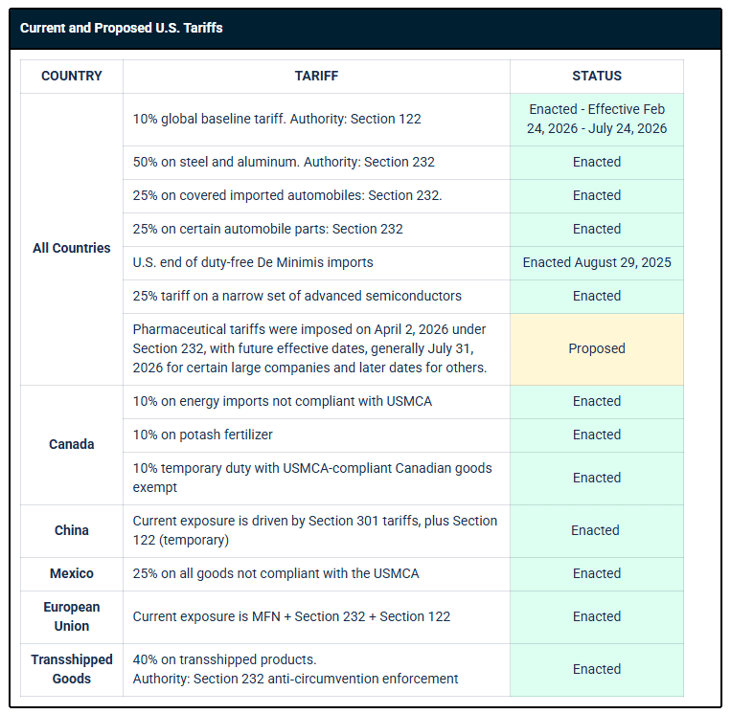
This resource is designed to help GPO members navigate uncertainty and plan effectively for the year ahead.Latest Update: Effective February 24, 2026, the Trump administration has replaced the now-defunct IEEPA tariffs with a 10% global tariff under Section 122 of the Trade Act of 1974, a move triggered by the Supreme Court’s ruling that IEEPA cannot be used to levy duties. This new “balance of payments” tariff applies uniformly to most trading partners for a 150-day window, though it maintains critical exceptions for USMCA-qualified goods and specific pharmaceuticals and medical ingredients mirrored from previous lists. While this provides a temporary legal bridge, the administration is simultaneously launching broad Section 301 investigations to establish more permanent, country-specific trade barriers by this summer.
📥 Check out the full report on pharmacy-specific insights here PharmaceuticalTariffUpdates-February_March2026.pdf
📞 For questions or deeper discussion, reach out to Sudha Narayanaswamy at sudha_narayanaswamy@premierinc.com.
Tracker for Supplier Submitted Price Increases
Out of the thousands of contracts Premier manages, only a small number of suppliers have submitted requests for price increases related to tariffs. We’ve compiled these into a list to help our members and account management teams track them more easily.
-
Visit the Value Assurance Community to view an up-to-date tracker.
For additional questions about a specific supplier or contract, please reach out to Talmadge_Patterson@PremierInc.com.
Sunsetting of Premier’s Tariff Impact and Risk Modeling System
Following the Supreme Court’s decision that the International Emergency Economic Powers Act (IEEPA) does not authorize the imposition of tariffs, and the subsequent termination of all IEEPA‑based tariffs, Premier has sunset the Reciprocal Tariff (IEEPA) Impact and Risk Modeling System.
With respect to current trade actions and based on current conditions, at this time Premier does not anticipate that the recently announced Section 122 tariffs will affect contracted pricing during the period they are in effect (up to 150 days, or through July 24, 2026). Consistent with this approach, Premier has also temporarily archived the pharmaceutical tariff dashboard and is not including tariff‑associated pricing estimates in the March update of the bi‑annual Drug Budget Tool.
Situation Report
6/5/26 - USTR advancing new Section 301 actions
- Brazil-specific action under review
- Proposed tariffs of approximately 25% on a broad range of Brazilian imports
- Action remains in the public comment phase, with written feedback due July 1 and hearings scheduled for early July
- Broad forced labor enforcement action across 60 economies
- Proposed additional duties of ~10% to 12.5% depending on compliance with forced labor restrictions
- Applies across approximately 60 major trading partners and would impact a wide range of imported goods
Source - USTR issues Section 301 determination on Brazil
Source - U.S. proposes fresh tariffs on 60 economies
6/1/26 - Section 232 Tariff Update, Targeted Relief and Expanded Coverage - Effective June 8, 2026 through December 31, 2027
- Incentives strengthened for U.S. content and regional sourcing - Lowered U.S. content threshold to 85 percent and new USMCA approach taxing only non-U.S. content, with a 15 percent minimum effective rate
- Selective relief for equipment categories - Tariffs reduced to 15 percent for certain agricultural, residential HVAC, and qualifying industrial equipment, expanding access to lower rates
- Expanded tariff scope on derivative products - Additional items, including steel racks and aluminum lithographic plates, now subject to 25 percent tariffs
- U.S. Customs and Border Protection is launching a dedicated claims portal to process refunds tied to tariffs imposed under the International Emergency Economic Powers Act that were struck down by the courts.
- The refund process is phased, with CBP estimating that roughly 63% of refunds will be handled in the initial stage, focused on certain unliquidated entries and those nearing liquidation.
- Refund recovery will be documentation‑intensive, requiring detailed importer‑of‑record data, shipment details, duties paid, and, in some cases, evidence of whether costs were absorbed or passed through in pricing.
- CBP reports strong early participation, with tens of thousands of importers already enrolled to receive electronic refunds, representing a significant share of duties paid.
Source: https://www.supplychaindive.com/news/trump-cbp-tariff-refund-process-what-to-know/817813
4/2/26 - The Trump administration Releases Two Executive Orders.
- White House Strengthens Section 232 Tariffs on Aluminum, Steel, and Copper Imports
- The President issued a proclamation modifying existing Section 232 tariff regimes to apply ad valorem duties to the full customs value of aluminum, steel, and copper articles and covered derivative products, regardless of metal content. Effective April 6, 2026, most covered products will face 25 percent or 50 percent tariffs, with reduced rates available for certain U.K. products and for derivative articles made entirely with U.S. origin metals.
- White House Adjusts Imports of Pharmaceuticals and Pharmaceutical Ingredients Under Section 232
- The President issued a proclamation determining that imports of pharmaceuticals and pharmaceutical ingredients threaten to impair U.S. national security, citing heavy reliance on foreign manufacturing for finished drugs and active pharmaceutical ingredients. The action establishes a Section 232 framework to adjust pharmaceutical imports, with the goal of reducing dependence on foreign supply chains and strengthening domestic drug manufacturing capacity.
3/4/26 – Section 122, Temporary Tariff Authority Explained
- Section 122 gives the President fast, temporary authority to impose uniform import restrictions, including tariffs of up to 15% or import quotas, when a large or imminent U.S. balance‑of‑payments deficit is declared, without the investigations required under Sections 232 or 301.
- Following the Supreme Court’s invalidation of IEEPA tariff authority, President Trump invoked Section 122 for the first time, imposing a 10% global tariff effective February 24, 2026, with select exemptions such as pharmaceuticals and USMCA‑qualifying goods.
- Section 122 tariffs are limited in scope and duration, must apply uniformly across all countries, cannot exceed 15%, and automatically expire after 150 days (July 24, 2026) unless Congress votes to extend them, creating near‑term uncertainty.
- The administration views Section 122 as a bridge, signaling a longer‑term strategy that may rely on other trade authorities such as Sections 232 and 301 to pursue more targeted or higher tariffs, amid ongoing legal and political uncertainty.
Premier and External Resources
- Section 122, What It Is and Why It Matters
- Trade Tracker - Presidential Actions
- Reciprocal Tariffs – Fact Sheet, and Executive Order
- Canada Tariffs – Fact Sheet
- Tariff Tracking on Suppliers, Purchase Items & Payments in Workday
- Reciprocal Tariff Amounts - Annex I
- HTS Codes - Annex II
- Premier's Foodservice Tariff Information
- Premier's Statement on White House Tariff Announcements
- Premier Responds to the Administration’s Call for Input on Trade Policies
- Trump's new tariffs include pharma exemption
- White House unveils sweeping tariffs: 5 notes - Becker's Hospital Review | Healthcare News & Analysis
- News From the White House